
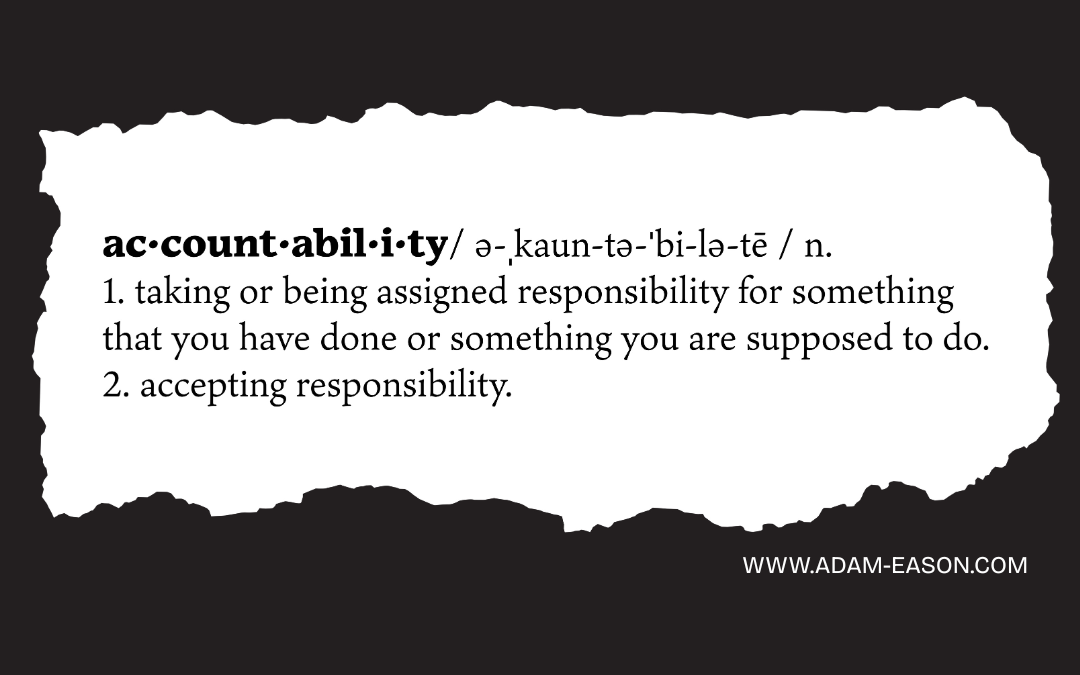
How do you hold yourself accountable? Yesterday we began our online body mastery programme and it has accountability inherently built into it, yet it also includes ways to hold yourself accountable and with it being fresh in my mind I thought I’d write about ways to hold yourself accountable today.
Accountability is a crucial component of personal development and mental health and has the backing of research to support it’s application and use. When we hold ourselves accountable, we take responsibility for our actions, decisions, and their outcomes. This sense of responsibility can significantly enhance our motivation, bolster our resilience, and contribute to our overall wellbeing. Today, I’m exploring and sharing various psychological strategies to help you hold yourself accountable in life, all supported by scientific research.
Understanding Accountability
Before diving into the strategies showing how to hold yourself accountable, it is essential to understand what accountability means in a psychological context. Accountability involves recognising one’s role in events and being answerable for the consequences of our actions. Dr. Brené Brown, a research professor and author, states, “Accountability is the ability to assess our own behaviour and its impact on others” (Brown, 2018). This self-awareness and self-assessment is at the heart of personal growth and development, fostering a healthier mindset.
Psychological Strategies to Hold Yourself Accountable
Set Clear and Specific Goals
Goal-setting is a foundational step in holding yourself accountable. Research by Locke and Latham (2002) shows that specific and challenging goals lead to higher performance than vague ones. When setting goals, use the SMART criteria: Specific, Measurable, Achievable, Relevant, and Time-bound. By articulating what you want to achieve, you create a roadmap that facilitates accountability. One of the things that being goal-focused can do is advance consistency. Consistency is key as you seek to hold yourself accountable and work towards goal.
Read more on this topic here: How to be More Consistent in Life.
Develop a Routine
Creating a consistent routine reinforces accountability. According to a study published in the Journal of Applied Psychology by Grusky (2012), structured routines promote self-regulation. When daily tasks become habitual, you’re more likely to follow through on your commitments. For example, if you want to exercise more, schedule a specific time each day for physical activity.
Read this great article for more on this topic: Why You Need Routine in Your Life.
Use Accountability Partners
Having an accountability partner can significantly boost your commitment to goals. Research by Rousmaniere and collaborators (2011) found that social accountability greatly enhances motivation. An accountability partner can be a friend, family member, or colleague who supports and checks in on your progress. Regularly discussing your goals with them encourages you to stay on track.
Keep a Journal
Journaling provides a space for self-reflection and is an effective tool for accountability. A study by Smyth (2008) demonstrated that expressive writing can promote emotional and psychological wellbeing. Writing about your goals, progress, and setbacks allows you to confront your behaviours, identify patterns, and track your journey towards accountability.
Reflect on Your Progress
Regularly reviewing your achievements and setbacks can significantly enhance accountability. According to a study in the journal Psychological Bulletin, self-reflection is associated with increased self-awareness and personal growth (Grant, 2007). Take time weekly to assess what worked, what didn’t, and how you can adjust your strategies moving forward.
Use Positive Reinforcement
Positive reinforcement encourages continued behaviour. Behavioural research suggests that rewarding yourself for achieving milestones can strengthen your commitment to accountability (Skinner, 1953). For instance, if you successfully complete a week of your exercise goal, treat yourself to something you enjoy as a reward.
Visualise Your Success
Visualisation techniques can enhance motivation and accountability. Research in cognitive psychology shows that imagining successful outcomes can increase the likelihood of achieving them (Taylor et al., 1998). Spend a few minutes each day visualising your success, cementing in your mind the benefits of holding yourself accountable.
Self-hypnosis is a great tool to help with self-care and some of the exercises outlined here in this article, you can go and Learn Self-Hypnosis Here for free.
Practice Self-Compassion
Being kind to yourself in moments of failure is crucial for maintaining accountability. A study by Neff (2003) found that self-compassion promotes greater emotional resilience and fewer feelings of worthlessness. Acknowledge setbacks without harsh judgement, and remind yourself that growth is a process that includes mistakes.
Read this article for more on this topic: How to Develop Self-Compassion.
Create Public Commitments
Making your goals known to others can increase your sense of accountability. Studies show that public commitments enhance adherence to goals (Cialdini, 2000). By sharing your objectives with friends or social media, you add an external layer of expectation, motivating you to follow through.
Investigate the Underlying Beliefs
Many individuals struggle with accountability due to distorted beliefs about themselves. Cognitive-behavioural therapy (CBT) focuses on recognising and restructuring these thoughts. Research by Beck (2011) shows that identifying negative thought patterns and replacing them with constructive beliefs facilitates personal responsibility and accountability.
Benefits When You Hold Yourself Accountable
Research suggests that holding yourself accountable offers numerous psychological benefits:
- Increased Motivation: Understanding your progress fuels intrinsic motivation.
- Enhanced Self-Esteem: Successfully pursuing your goals boosts your confidence and self-worth.
- Better Decision-Making: Accountability encourages mindful decision-making, leading to more thoughtful actions.
- Greater Resilience: Acknowledging your role in failures cultivates resilience and determination.
- Improved Relationships: Taking responsibility for your actions positively influences your interpersonal relationships.
So, to round things off today… Accountability is more than a personal obligation; it is a transformative psychological practice that fosters growth, well-being, and resilience. By implementing the strategies outlined above, you can enhance your capacity to hold yourself accountable in various areas of life. Remember, as Dr. Brené Brown aptly puts it, “Vulnerability is the birthplace of innovation, creativity, and change,” and embracing accountability is a crucial part of that journey.
References
- Beck, J. (2011). Cognitive Behavior Therapy: Basics and Beyond. Guilford Press.
- Brown, B. (2018). Dare to Lead: Brave Work. Tough Conversations. Whole Hearts. Random House.
- Cialdini, R. (2000). Influence: Science and Practice. Allyn & Bacon.
- Grant, A. M. (2007). The Impact of Life Coaching on Goal Attainment. Psychological Bulletin, 133(5), 825-859.
- Grusky, O. (2012). The Role of Routines in Encouraging Self-Regulatory Behaviors. Journal of Applied Psychology.
- Locke, E. A., & Latham, G. P. (2002). Building a Practically Useful Theory of Goal Setting and Task Motivation: A 35-Year Odyssey. American Psychologist, 57(9), 705–717.
- Neff, K. (2003). Self-Compassion: An Alternative Conceptualization of a Healthy Attitude Toward Oneself. Self and Identity, 2(2), 85-101.
- Rousmaniere, T., et al. (2011). The role of the peer-based accountability partner in goal achievement.
- Skinner, B. F. (1953). Science and Human Behavior. Macmillan.
- Smyth, J. M. (2008). Written Emotional Expression: Effect Sizes, Impact Models, and Implications for Practice. Journal of Consulting and Clinical Psychology, 76(3), 350–359.
- Taylor, S. E., et al. (1998). Biobehavioral Responses to Stress in Females: Tend-and-Befriend, Not Fight-or-Flight. Psychological Review, 107(3), 411-429.
Have some of themes here resonated with you? Then have a read of these pages:
Would you like a satisfying and meaningful career as a hypnotherapist helping others? Are you a hypnotherapist looking for stimulating and career enhancing continued professional development and advanced studies? Adam Eason’s Anglo European training college.
Likewise, if you’d like to learn more about self-hypnosis, understand the evidence based principles of it from a scientific perspective and learn how to apply it to many areas of your life while having fun and in a safe environment and have the opportunity to test everything you learn, then come and join me for my one day seminar which does all that and more, have a read here: The Science of Self-Hypnosis Seminar. Alternatively, go grab a copy of my Science of self-hypnosis book.


